
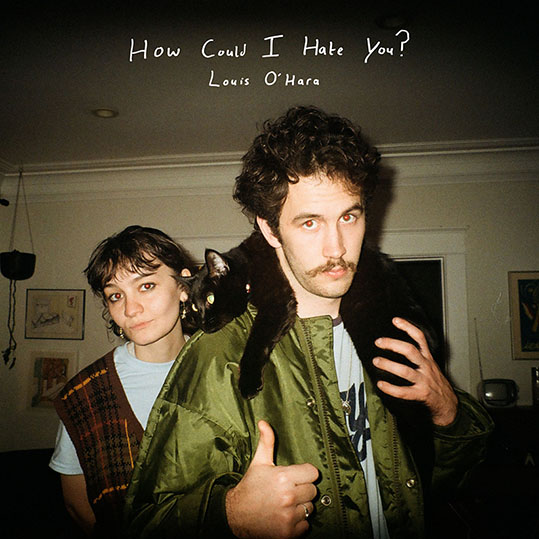
How Could I Hate You? is the second full-length album from Louis O’Hara written on a secret tour of the US West Coast in January 2026 and recorded in March 2026 at Real World Studios in Wiltshire with James Trevascus (engineer to Billy Nomates, Nick Cave & Warren Ellis, Young Fathers etc). The record features a range of musical contributions from Louis’ live band, His Burley Chassis, as well as a guest vocal from contemporary folk artist Naima Bock on the track “Two Balloons”. The new album is an assured step forward for O’Hara who established himself as one of Wales’ most compelling emerging voices on his debut album A Peaceful Kind of Fun in November 2025.
The album artwork speaks volumes about this next step for Louis. On it, he is looking straight into the camera, direct and playful. Taken in LA, the photograph shows him holding a cat named Fosse (after the legendary director of All That Jazz) around his neck and accompanied by Gem Stark, who plays bass and electric guitar on the album as well as lead vocals on the song “Windowsill” and backing vocals throughout the record. The choice of album cover was a very deliberate one. Shot candidly on a 35mm camera with messy hair and moustache and red eyes from the flash, it shows that Louis is not aiming for perfection but instead wants to present something genuine and vulnerable, and that is exactly what How Could I Hate You? does.
Album opener “Never About Money” is a tongue in cheek song of frustration. A playful “do one” to rich daddy’s boys trying to bend Louis to their will. It is also a reminder that words can have consequences and things spread quickly in the music scene. The upbeat arrangement built around the main harmonica riff creates a jovial yet tense atmosphere, akin to that of a spaghetti western movie. This is O’Hara at his most mid-60s Bob Dylan, taking a walk down “Positively 4th Street”.
“Bywyd Braf (A Fine Life”) follows, a song of longing for the quiet life so many now strive for. For Louis, that life is just out of reach due to the necessities of modern living. Situated in West Wales, for Louis it is on his doorstep but the song laments that he must first exhaust themself in the city to achieve anything, only then can he enjoy a slow pace of life in the country.
The fourth track on the album, and potentially the sweetest, “I Knew You” tells the story of a childhood best friend who was with Louis from age 2 through to 16. It’s a simple yet deeply relatable song of friendship. It reminds the listener that you can still feel the significance of someone even if you haven’t seen them for years. There’s a shamelessness to the country influences of this track. The arrangement is adorned with pedal steel by West Wales’ finest country gent Gwyn Rosser and the backing vocals are reminiscent of those heard on Marty Robbins’ records.
“Two Balloons” closes the A-side and came from a moment in Louis’ life, then living in London, where he and his partner were conversing about breaking up, but a pair of gold balloons flew past their flat window and it changed everything. So transfixed at watching them float into the sky and disappear into the sun, they forgot where they were atwith their argument, left it where it was, and stayed together. The song was written while O’Hara was hugely into Leonard Cohen, and the arrangement stays true to that, you can hear the influence of Cohen’s masterpiece “Famous Blue Raincoat”.As well as featuring beautiful loungey piano from Lois Plummer, “Two Balloons” is a duet featuring Naima Bock.
B-side starter “For Now, We’re Apart” is Louis allowing his early Velvet Underground influences to really come through. The lyrics are those of frustration, taking place somewhere in the middle of a romantic journey where the ending isn’t quite clear. Seeing someone you love in a relationship you both know is no good, but also knowing there’s nothing you can do about it. The ending of the song lets rip and goes full John Cale, harsh clarinets, strings and distorted voices leave the song ending in what feels like a real time panic attack.
The panic attack continues on the following track “Psycho”. A cover of a murder ballad originally written by Leon Payne. This song has been in Louis’ live sets since the beginning and is a favourite amongst audiences. The track perfectly showcases the darker side to Louis’ personality and music, with the lyrics of the song changed to have O’Hara, as the protagonist, murder each of his band mates one by one, as well as James and Xav Sinden who produced and engineered the album. As each of the deceased are named, they leave behind a musical motif, such as piano trill or guitar riff. In James’ case it is a scream Alfred Hitchcock would’ve been happy with.
“Windowsill” is an early song of Louis’ written when he was living in London and finished while on tour in America. At the flat he lived in in the Big Smoke there was a windowsill directly opposite his window and there would always be the same two birds together. The longer he spent in London the more exhausted he became, mentally and physically, and he noticed the birds were aging too. A very real, visual metaphor for him and his partner’s relationship and his relationship with the city he lived in. This song is another duet, this time featuring bandmate, Gem Stark.
The most personal song on the album, and probably the most devastating is “Memory”. The lyrics are fairly matter of fact and explore the grief of losing a close family friend. The song is profoundly rooted in place, that place being Pembrokeshire. With references to coastal walks and playing on the swings. There is reference to ‘seeing the game last night’, a playful nod to football which was a big part of Louis’ male relationships growing up.
Another song of longing is the album’s penultimate track “Beth Bynnag A Ddaw (Whatever Comes)”. It details two love interests sharing a beautiful moment under stars, simultaneously wishing in their minds to be together. The scene is based on a true story, in which shooting stars shot over the small 6th century city of St. David’s. The instrumental section of the song conjures feelings of transition and excitement, as stars shoot across the sky and the relationship between the two protagonists’ change. It features GWEN, coming in on verse 2, voicing the inner thoughts of the female protagonist, revealing she too wants to be together.
The album’s closer and most romantically heartbreaking is the title track “How Could I Hate You?” The song details a time with a love interest when all of Louis’ friends told him it would just be easier to hate them and move on. In reality he loved them far too much to ever do that and so the song was written. The lyrics are about not losing hope of what feels like true love and wanting to spend all of your time with one special person who makes you feel amazing when you’re together, something everyone can relate to from some period in their life. The arrangement is thoughtfully sparse and creates a real feeling of intimacy to close the album, like everything else has been stripped away and now Louis O’Hara is alone, singing to just you.
This album is O’Hara at his most ambitious, at times devastating, at times funny and at times devastatingly funny. The lyrics are equal cheekiness and tenderness and are supported by music from his band that lends from baroque, country, rock, classic folk and countless other genres. The cherry on the cake is the expert production and mixing from Louis’ co-producer James Trevascus, who has helped shape an album that feels completely timeless.
